
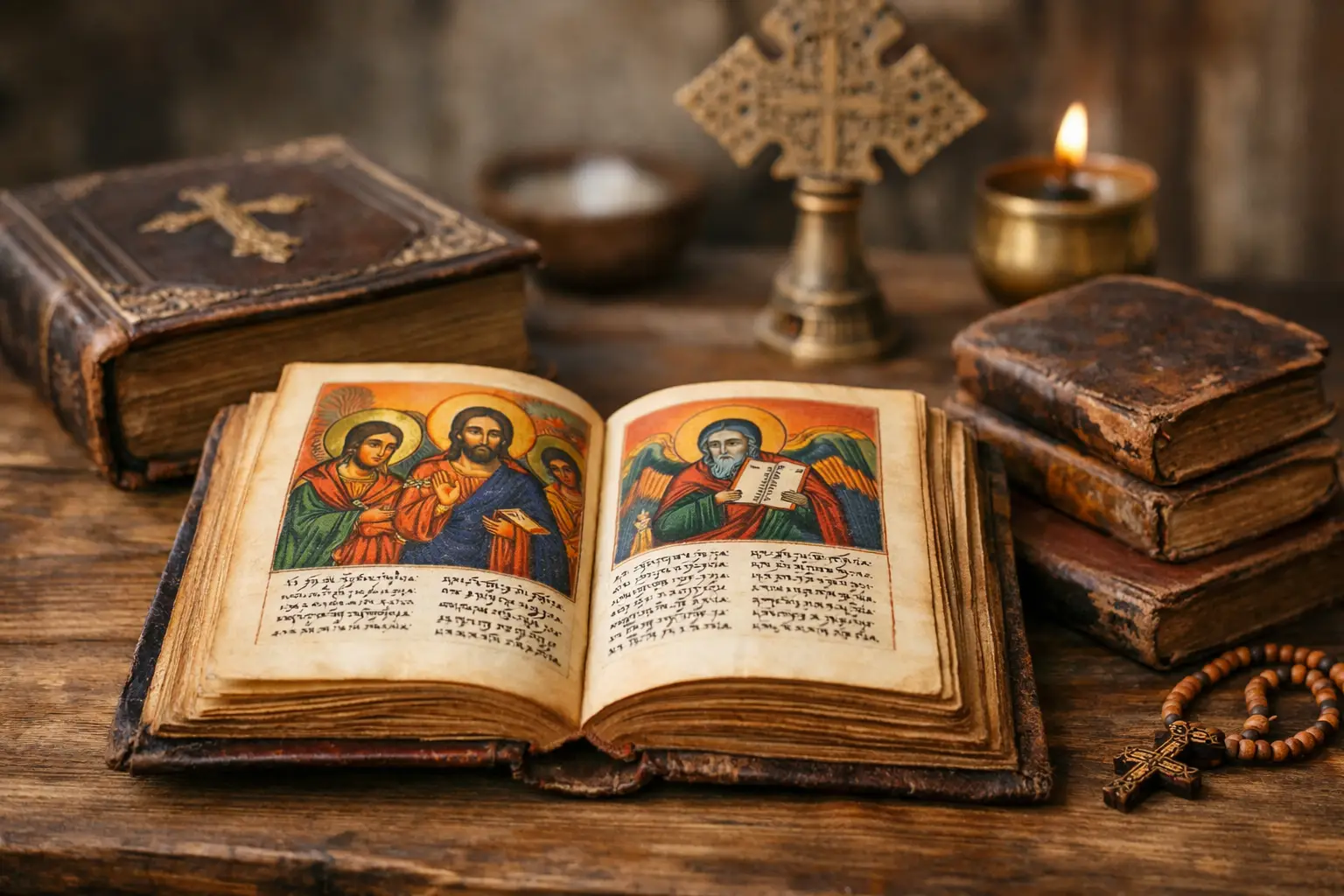
What Ethiopian Bible Extra Books Actually Include
For readers raised with a 66-book Protestant Bible, the phrase Ethiopian Bible extra books can sound like a hidden shelf of forbidden scripture. The reality is more interesting. The Ethiopian Orthodox Tewahedo Church preserved a wider biblical tradition, including books familiar to many Catholic and Orthodox readers as well as works such as Enoch and Jubilees that most Western Bibles leave out.
These books are not a recent discovery, and they are not simply a stack of texts added to a standard English Bible. They belong to a living canon shaped by worship, manuscript history, theology, and the ancient Ge'ez language tradition. That distinction matters if you want to read them fairly.
Why the Ethiopian canon is different
Every biblical canon answers a question: which writings does a faith community receive as scripture? Christians have not answered that question in exactly the same way. Protestant, Catholic, Eastern Orthodox, Syriac, and Ethiopian traditions have overlapping Bibles, but their boundaries are not identical.
The Ethiopian Orthodox Tewahedo Church is commonly said to have an 81-book canon. That number is useful, but it can also create confusion. Lists of the books may differ depending on whether someone is describing the narrower canon used most directly in biblical reading or the broader canon that includes church-order and ecclesiastical writings. Ancient manuscripts and modern printed editions do not always arrange or count books in the same way either.
So it is better to ask, “Which texts does this Ethiopian tradition receive and use?” rather than assume there is one modern table of contents that settles every question. The canon is real, but its presentation is more layered than a bookstore inventory.
Ethiopian Bible extra books in the Old Testament
Several books associated with the Ethiopian canon will already be familiar to readers of Catholic or Eastern Orthodox Bibles. These include Tobit, Judith, Wisdom of Solomon, Sirach, Baruch, and the Letter of Jeremiah. Protestant readers often call these books Apocrypha; Catholic readers generally call many of them Deuterocanonical books.
The most discussed Ethiopian texts, however, are 1 Enoch, Jubilees, and the books called Meqabyan. Their presence makes the Ethiopian biblical tradition especially important to anyone studying Second Temple Judaism, early Christianity, angels, giants, covenant, and the development of biblical interpretation.
1 Enoch
1 Enoch is perhaps the best-known of the Ethiopian books outside most Western canons. It is a collection of writings that addresses fallen angels, the Watchers, judgment, heavenly journeys, wisdom, and the coming righteous one. Its story of rebellious angels taking human wives shaped later Jewish and Christian imagination, especially interpretations of Genesis 6.
Enoch was known in the ancient world. The New Testament letter of Jude echoes and directly cites a prophecy attributed to Enoch, and fragments of Enoch were found among the Dead Sea Scrolls. Yet the complete text survived chiefly in Ge'ez through the Ethiopian tradition after Greek and Aramaic copies became fragmentary or disappeared.
That survival does not mean every Christian tradition must treat Enoch as canon. It does mean the book cannot honestly be dismissed as a late invention or a curiosity with no ancient roots.
Jubilees
Jubilees retells much of Genesis and the opening of Exodus through a distinctive lens. It organizes sacred history into periods of jubilees, emphasizes covenant faithfulness, gives expanded accounts of patriarchal events, and presents a strong concern for Sabbath, festivals, and purity.
For modern readers, Jubilees can feel both familiar and surprising. Abraham, Noah, Jacob, and Moses are there, but their stories carry details and interpretations not found in Genesis. The book helps show how ancient Jewish communities did not merely repeat Scripture. They read it, prayed over it, and explained its meaning for their own obedience.
Meqabyan is not Maccabees
One frequent mistake is to equate Ethiopian Meqabyan with the Greek books of 1, 2, 3, or 4 Maccabees. They are not the same works. Ethiopian tradition includes 1, 2, and 3 Meqabyan, but their stories and themes differ significantly from the familiar Maccabean accounts of the Jewish revolt against Antiochus IV.
The Meqabyan books focus strongly on fidelity to God, the danger of idolatry, righteous suffering, and divine judgment. The similar names have led to many bad book lists and careless comparisons. If you are buying or borrowing a collection, check whether it contains Meqabyan or Greek Maccabees. The difference is not minor.
The broader Ethiopian canon and New Testament writings
The conversation becomes more complicated in the New Testament. Alongside the 27 books recognized across mainstream Christian traditions, Ethiopian canonical discussions may include works connected to church order and apostolic instruction. These are often named as Sinodos, the Book of the Covenant, Ethiopic Clement, and Didascalia.
This does not mean Ethiopian Christians have a secret alternate Gospel or a different account of Christ's life. The four Gospels, Acts, Pauline letters, Catholic Epistles, and Revelation remain central. The additional writings reflect the church's concern for worship, discipline, communal order, and apostolic teaching.
For a reader approaching these texts from outside the tradition, genre is essential. A book of visionary judgment, a retelling of Genesis, and a manual for church life should not be read as though they are all doing the same work. Scripture itself contains law, poetry, prophecy, gospel, letter, genealogy, and apocalypse. The wider canon asks readers to become more attentive, not less.
Why were these books left out of most English Bibles?
“Left out” can suggest a single meeting where someone removed books from a complete Bible. History is less clean than that. Different Jewish and Christian communities inherited different collections, languages, liturgical habits, and standards of authority. A text might be widely read in one region, valued but non-canonical in another, or gradually lost where copies were no longer made.
The Reformation sharpened the divide for English-speaking Christians. Protestant Bibles generally separated or excluded books that Roman Catholics and Orthodox churches retained. Ethiopian Christianity developed along a different historical path, preserving traditions in Ge'ez and maintaining connections with the wider ancient Christian world without becoming identical to Greek, Latin, or later Protestant practice.
There is a trade-off in every approach. A narrower canon offers a sharply defined common collection. A wider canon preserves more of the interpretive world around biblical faith. Neither option allows a reader to avoid the work of discernment, history, and prayer.
How to read these books without forcing them to prove a point
Start by resisting two temptations. The first is treating every non-canonical text as dangerous simply because it is unfamiliar. The second is treating every excluded text as proof that established Christianity hid the truth. Both reactions replace reading with suspicion.
Read Enoch beside Genesis 6, Daniel, Jude, and Revelation. Read Jubilees alongside Genesis and Exodus. Read Meqabyan on its own terms before comparing it with Maccabees. Notice where a text expands a biblical theme, where it reflects the concerns of its community, and where it challenges assumptions you may have carried into the reading.
A good edition should identify the source tradition, distinguish complete surviving texts from reconstructed fragments, and avoid pretending that every ancient work carries equal authority in every church. Commentary can help, but the text deserves room to speak before someone tells you what you must think about it.
What these books offer the serious reader
The Ethiopian canon reminds us that the Bible did not descend into history with a modern English table of contents and uniform study notes. It came through communities that copied, sang, translated, debated, guarded, and handed down sacred writings across centuries.
That does not require abandoning the canon you know. It does require honesty about the fact that Christian Scripture has a larger and more complicated history than many of us were taught. For readers drawn to apocryphal, rejected, and non-canon writings, Ethiopian tradition is not a side road. It is one of the clearest surviving witnesses to how wide the ancient scriptural imagination could be.
Read these books with an open Bible nearby, a careful mind, and enough patience to let an old voice remain old before demanding that it sound like your own.


Comments